 Ahoy, me salty seadogs/wenches/malcontents. Even though Talk Like a Pirate Day is a good five months away, I thought that since I have nothing more interesting or enriching to contribute, we could talk about pirates. And money. So money and pirates. And how they’re connected.
 All of the viewing, reading and intravenous consumption of material for this unit has piqued my awareness of history in film and other media forms. We look to the past for wisdom, enlightenment, and, if your name is Jerry Bruckheimer, a fifth house. One prime example of the latter is the way in which we’ve ‘ARGH-sploited’ pirates over the last decade or so with countless millions and the occasional cult fan base trickling into the pockets of big brother, or rather, The Walt Disney Company and LucasArts
Now, in order to contextualise this, let’s look quickly at the original cultural product on which the cash-cow offshoots are based.
Pirates of the Caribbean
A ride in a park belonging to Walt Disney, based on pirates.
 My mother never took me to Disneyland (please don’t ask why, I won’t be able to answer because my throat is crushed beneath the weight of the pain caused by my mother never taking me to Disneyland). HOWEVER. When I was a child I had a Disney sing-a-long video that featured this particular ride, and the “Yo-ho-yo-ho-a-Pirate’s-life-for-me” song, intercut with footage from Treasure Island. Truth be told, it scared the pieces’o’eight out of me, and I never really liked ‘them’ (i.e. pirates) when I was little. Still, it was a bit less racist than the rest of the video (The Three Caballeros? Really?!) so I used to watch it and sing along mindlessly in the way that three-year-olds inevitably do.
 The animatronics, rosy cheeks, and robust tuneful singing voices are hardly accurate. However, this attraction, slow and terrifying as it may be is one of the most popular and well-loved rides in the park. That said, the ride has been modified several times since its 1967 launch in an attempt to avoid the awkward questions that so often follow a child seeing an overweight pirate chasing a teenaged girl.
The Monkey Island Games
A series of video games, based on the same ride, based on pirates. Made by George Lucas’s videogame offshoot. Released way before Pirates of the Caribbean was a movie.
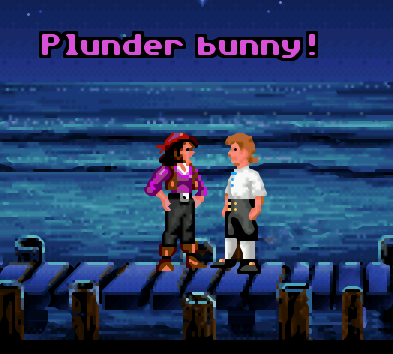 Now this is my favourite. Thoughout the series, which spans The Secret of Monkey Island, Monkey Island 2: LeChuck's Revenge, The Curse of Monkey Island and Escape from Monkey Island. We follow the story of young Guybrush Threepwood, a boy/man of humble origins and no real consequence who wants to be a pirate. There's Adventure, Romance, Insult Sword Fighting, and barely a drop of blood is spilt on-screen.
 Whilst these games did not enjoy huge commercial success, they were successful by 90s standards, establishing and maintaining a cult following which has most recently manifested itself in the form of fansites (including The World of Monkey Island, The Scumm Bar, and Legend of Monkey Island). Through perusing these sites it is evident that the demographic attracted to hardcore Monkey Island fandom are not those who would be attracted to raping, pillaging, and perhaps not putting out the wheelie bins in a restrained attempt at rebellion.
Pirates of the Caribbean 1, 2, and 3.
Three films based on a ride, based on pirates.
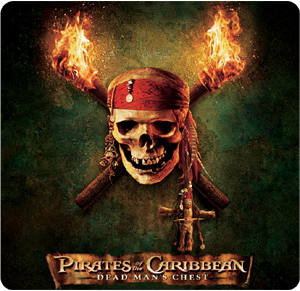 Yes, this next one is a bit obvious. But it had to happen. Keira Knightley, Johnny Depp, and Orlando Bloom. And yes, he is delicious. Action, Adventure, Rum-based humour, and jokes about whores here and there.
 In terms of factual accuracy, apart from the mythical sea creatures and the somewhat relaxed relationship with the underworld, these films probably contain the greatest amount of historical information about pirate lifestyles. It's also the most widely known and successful. The first film, The Curse of the Black Pearl, grossed $654,264,015 worldwide on its own. Add to this the next two films, lunchboxes, DVD sales and Johnny Depp posters, and you're looking at a multi-billion dollar franchise.
Let's juxtapose all of this with the factual experience of pirating.
Rape, murder, lighting things on fire and terrible dental hygiene, not to mention premature death and countless other unpleasantries.
I guess the question I’m asking is this: Why is history such a useful framework for contemporary creative exploits? Because, let’s face it, we’re projecting contemporary morals, beliefs and narratives onto these men and women of lower moral (and probably also dietary) fibre. Is it the benefit of distance and hindsight which allows us to laugh in a twee fashion at people who lived more often than not in a state of abject poverty, and who frequently committed an number of acts which we ourselves would otherwise consider deplorable?
The floor is yours. Discuss.

2 comments:
Yaargh!
I think there is an element of the 'other' involved, particularly with these bloody/almost unbelievable tales of sordid hedonism, pillaging, and violence.
Most Hollywood films though, don't really engage much with the 'historical' aspects of the stories they're retelling, its more of a 'there or thereabouts' kinda thing. And I'm torn on this commodification, I love Roman and Hellenistic history, and so was kinda enthralled at Troy and Alexander, and the Rome TV series, but with Troy and Alexander, I felt it was underwhelming and found myself saying...hey...that's not how it happened!? (Rome though is quite awesome).
So I'm torn on people finding out about these stories, and perhaps through interest, do a Wikipedia search and read up on it, and perhaps get a better understanding and the idea of a commodified history.
*stops procrastinating and goes back to the review*
Great post, Rhiannon! One of my other jobs in the history department is lecturing on a unit called 'history on film' and you've has summed up the big question of that unit - is 'history' (and I think when discussing Pirates of the Carribbean we are using this term rather loosely) on film any good (and if its good, what is it good for?)? We can hope that audiences might be inspired to read more if they see a film about a period of history that interests them, but on the other hand, most people won't do this. For some audiences I'm sure that historical films are escapist - Jane Austen adaptations never deal with the realities of life for women of Austen's age and class, but they offer a world to escape into that is somehow fake but still 'real' (that is, it's not 'Lord of the Rings'-style pointy-ears fantasy). Hmm...
But perhaps these films will spawn a cottage industry of 'the real pirates', 'the real Alexander' - 'real' historians can fill in the gaps of these films. Or you can go the reality TV route - 'Regency House Party' (12 men and women lived as Jane Austen's heroines did, and all the women nearly died of boredom and dirty hair), or the considerably more dreadful 'Pirate Master' with Cameron Daddo - I think it lasted just two episodes here.
But seriously, even bad history is an opportunity to find an interested audience, although I don't think any academic histories have had theme park rides based on them yet...
Post a Comment