Wednesday, April 23, 2008

Commodifying History: Argh!

Ahoy, me salty seadogs/wenches/malcontents. Even though Talk Like a Pirate Day is a good five months away, I thought that since I have nothing more interesting or enriching to contribute, we could talk about pirates. And money. So money and pirates. And how they’re connected.

All of the viewing, reading and intravenous consumption of material for this unit has piqued my awareness of history in film and other media forms. We look to the past for wisdom, enlightenment, and, if your name is Jerry Bruckheimer, a fifth house. One prime example of the latter is the way in which we’ve ‘ARGH-sploited’ pirates over the last decade or so with countless millions and the occasional cult fan base trickling into the pockets of big brother, or rather, The Walt Disney Company and LucasArts

Now, in order to contextualise this, let’s look quickly at the original cultural product on which the cash-cow offshoots are based.

Pirates of the Caribbean
A ride in a park belonging to Walt Disney, based on pirates.

My mother never took me to Disneyland (please don’t ask why, I won’t be able to answer because my throat is crushed beneath the weight of the pain caused by my mother never taking me to Disneyland). HOWEVER. When I was a child I had a Disney sing-a-long video that featured this particular ride, and the “Yo-ho-yo-ho-a-Pirate’s-life-for-me” song, intercut with footage from Treasure Island. Truth be told, it scared the pieces’o’eight out of me, and I never really liked ‘them’ (i.e. pirates) when I was little. Still, it was a bit less racist than the rest of the video (The Three Caballeros? Really?!) so I used to watch it and sing along mindlessly in the way that three-year-olds inevitably do.

The animatronics, rosy cheeks, and robust tuneful singing voices are hardly accurate. However, this attraction, slow and terrifying as it may be is one of the most popular and well-loved rides in the park. That said, the ride has been modified several times since its 1967 launch in an attempt to avoid the awkward questions that so often follow a child seeing an overweight pirate chasing a teenaged girl.

The Monkey Island Games
A series of video games, based on the same ride, based on pirates. Made by George Lucas’s videogame offshoot. Released way before Pirates of the Caribbean was a movie.
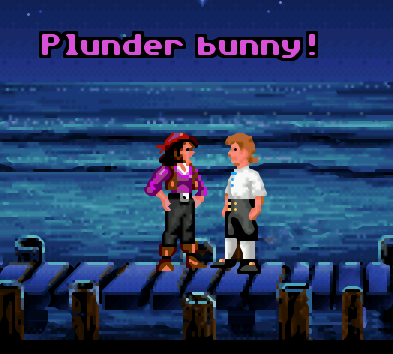
Now this is my favourite. Thoughout the series, which spans The Secret of Monkey Island, Monkey Island 2: LeChuck's Revenge, The Curse of Monkey Island and Escape from Monkey Island. We follow the story of young Guybrush Threepwood, a boy/man of humble origins and no real consequence who wants to be a pirate. There's Adventure, Romance, Insult Sword Fighting, and barely a drop of blood is spilt on-screen.

Whilst these games did not enjoy huge commercial success, they were successful by 90s standards, establishing and maintaining a cult following which has most recently manifested itself in the form of fansites (including The World of Monkey Island, The Scumm Bar, and Legend of Monkey Island). Through perusing these sites it is evident that the demographic attracted to hardcore Monkey Island fandom are not those who would be attracted to raping, pillaging, and perhaps not putting out the wheelie bins in a restrained attempt at rebellion.

Pirates of the Caribbean 1, 2, and 3.
Three films based on a ride, based on pirates.
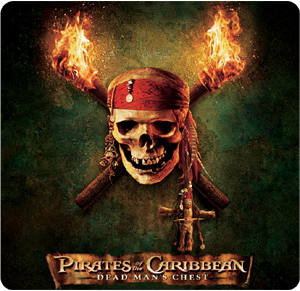
Yes, this next one is a bit obvious. But it had to happen. Keira Knightley, Johnny Depp, and Orlando Bloom. And yes, he is delicious. Action, Adventure, Rum-based humour, and jokes about whores here and there.

In terms of factual accuracy, apart from the mythical sea creatures and the somewhat relaxed relationship with the underworld, these films probably contain the greatest amount of historical information about pirate lifestyles. It's also the most widely known and successful. The first film, The Curse of the Black Pearl, grossed $654,264,015 worldwide on its own. Add to this the next two films, lunchboxes, DVD sales and Johnny Depp posters, and you're looking at a multi-billion dollar franchise.


Let's juxtapose all of this with the factual experience of pirating.

Rape, murder, lighting things on fire and terrible dental hygiene, not to mention premature death and countless other unpleasantries.

I guess the question I’m asking is this: Why is history such a useful framework for contemporary creative exploits? Because, let’s face it, we’re projecting contemporary morals, beliefs and narratives onto these men and women of lower moral (and probably also dietary) fibre. Is it the benefit of distance and hindsight which allows us to laugh in a twee fashion at people who lived more often than not in a state of abject poverty, and who frequently committed an number of acts which we ourselves would otherwise consider deplorable?

The floor is yours. Discuss.

Tuesday, April 22, 2008

Found Photographs

Visiting the Art Gallery of NSW on the weekend, I was intrigued to see (in the contemporary gallery downstairs) an exhibition of anonymous photographs, entitled Ghosts in the Machine. These mostly very small, black and white photographs were taken by unknown photographers and preserved by collectors. One the one hand, many of the photographs were poetic, absurd or surrealist images, often created by mistake. Yet they are also a precious record of everyday life, of ordinary people and the ways they sought to present themselves to the world -  we can gain access to a lost world through these private snapshots. These are the sorts of records Eurydice and Sharon might have yearned for when they were piecing together the life of Edna Lavilla, for example. They can also give us a sense of historical events from the point of view of the 'ordinary' person - one of the most striking (tiny) shots is of a group of WWII German soldiers running through the Hall of Mirrors in the Palace of Versailles. Who took the picture, and who was it for?

There are problems with this sort of work being exhibited, of course -  these were private photos that were never meant to become public, and I even found a website that offers 'vernacular photographs' for sale.  There is an intimacy to many of these images that made me feel slightly uncomfortable that they were on display in an art gallery, and not a history museum (or perhaps that they were on display at all). Are sites like flickr the contemporary equivalent of this phenomenon, where anyone can view anyone else's photographs, and where people who have posted their photos on these sites have found their images used in advertising campaigns? 


Tuesday, April 15, 2008

Forgotten History

It is interesting that Alec "Hunt Angels" Morgan should mention that large segments of history in Australia is forgotten information because it explains a lot of the reasons why Australians think and act as they do.

Then again, the same could be said of all countries and peoples which have been made subject to cultural imperialism from other more dominant nations. Be it Japan attempting to eradicate Korea's national heritage, Pol Pot attempting to re-write Cambodian mythology or Britain's Raj trying to keep India under its thumb, history has always been about power play and the repression of historical information.

In fact, my own heritage has been subject to just such a historical injustice.

In the early half of the twentieth century, the miners of Tonypandy (an industrial town in the Rhondda Valleys not far from where I grew up) led a peaceful protest against the coal board because they were not earning enough of a wage to feed their families. The MP assigned to deal with the strike was none other than that cruel drunk of a tyrant Winston Churchill, who rather than listening to the protestors ordered for mounted cavalry to ride in and trample them. Hundreds of men, women and children were killed in the ensuing chaos and Churchill became villified in the eyes of everyone in South Wales.

However, that incident was doctored and stricken from the record following the Second World War. As if helping Britain survive the onslaught of Nazi tyranny had stripped him of all wrong doing, Churchill was diefied as a national hero and historians were then coerced into altering the historical records as not to damage the romantic image which Churhill's legacy had created. Now children in South Wales are told that Churchill in fact REFUSED to use force and that the miners disbanded quietly after a few hours of negociation, but every one still knows the truth.

This acts as but another chapter in a long list of entries where State history and Folk history clash. Regardless of which side is correct, it must be noted that there is no real universal truth in this world and one's truth is another man's opinion. Hence it is just a matter of choice.

The Pointlessness of war

I've recently finished watching Park Chan-Wook's Joint Security Area - a film set around the supposedly infamous Bridge of No Return which seperates North and South Korea.

What I found particularly intriguing about this piece was the way in which it attempted to focalise the war from the perspectives of Soldiers from both sides who share the same view that the country should once more be unified and not from the typical nationalist binary of good/evil.

The interesting part comes when you consider that this perspective is also shared by many real people who live in other such conflicts and have appeared in non-fiction films. The best example I can think of off the top of my head comes from Oliver Stone's documentary Persona Non Grata when Stone's film crew was actually allowed to interview a Palestinian terrorist cell who claimed only to strive for a "unified, secular way of life".

The question I wish to pose is why in a partisan situation where both sides want the same thing does there still have to be so much pain and devastation. Why can't people just refuse to fight?

Of course, the problem with historical film comes from the opinion that it can also be used for reasons of propaganda to encourage hatred toward certain ethnic groups, with the best example being Leni Rifenstalh's Triumph of the Will. Even in today's supposedly liberally Democratic world, visual texts which work to provoke those sentiments of violence and hatred are still rampant.

Take, for instance, the upcoming Hugh Jackman film Australia, which attempts to document the Japanese air raid of Darwin's sea ports. Many people in the industry with whom I have discussed about this issue share my fears that this will become little more than a retelling of Pearl Harbor, hoping to promote Australian Nationalism and anti-Japanese feeling. The same can be said of all war films which promote partisan sentiments. War films or rather films about war often carry that emotional element which may lead to them becoming detrimental in a multicultural world and often have an adverse effect to what the film maker hopes to achieve.

Then again, these days it is not just films, books and newspapers which can promote war mongering attitudes. Television also palys a large part through the consistant coverage of veterans day, doctored news footage designed to only show the "good" segments of war and reality shows like Bad Lads Army which attempt to illogically 'reform' petty thugs by training them how to be killers.

The most partisan medium for attitudes to War is probably Videogames (yes, VGs are officially considered a legitimate form of media these days) which have since become the main forum of much debate on the ethics of war. On the one had, there are a swathe of RTS (Real Time Strategy) and FPS (First Person Shooter) games which appear to promote the concept of war and in the most extreme cases even glamorize it. On the other side of the spectrum are games like Metal Gear Solid and Assassin's Creed which attempt to contest these claims and prove that in war there can be no real good or bad side because the reasons people fight are always academic.

Perhaps what I am trying to get at with all this seemingly pointless philosophizing is, to quote Amnesty International's Howard Bell, humanity has not and can not advance as a species if we continue to consider war as a such an intrinsic part of our cultural heritage. Yes, greed and the desire for violence is part of human nature, but how long can people use those alibis to excuse the killing not just of soldiers but of innocent women and children. Not enough work has been done outside of niche market media to investigate the effects to which war has an effect on these people and it is a shame because that is exactly what wars are really about: people. Strip away all the layers of rhetoric and supposed meaning and one is left with the bare bones of what war is - human beings reverting back to their neolithic tendancies and killing other human beings.

More work should be done to promote truly egalitarian representations of how devastating war can be in order to finally ensure that the next generation can realise just how horrific wars really are and realise that we are all one species. One people...

Monday, April 14, 2008

Officialis

Trouble is brewing in the realm of Harry, Hermione and Ron, as questions of official-ness are brought into the light. JK Rowling is suing Steve Vander Ark, for his website/encyclopedia: HP Lexicon. Rowling alleges that the website, which is a very comprehensive collection of ideas arranged in an encyclopedic-hypertext format, has "simply taken it and copied it ... It is sloppy, lazy and it takes my work wholesale."

And in some regards Vander Ark has taken her words, at times quoting directly from Rowling in interviews she's given:

"I don't believe in witchcraft, though I've lost count of the number of times I've been told I'm a practicing witch. Ninety - let's say ninety five percent at least, of the magic in the books in entirely invented by me. And I've used things from folklore and I've used bits of what people used to believe worked magically just to add a certain flavor, but I've always twisted them to suit my own ends. I mean, I've taken liberties with folklore to suit my plot."
- J.K. Rowling on magic in the books (HPM)


But at the same time, he's also collated various essays from fans on topics dealing with the relevant issues:


What is interesting, even though this is is a fictitious story we're debating about, is the idea of officialness and its position as priviliged over 'unofficial' or 'rivalling' or 'fan' collections or archives. When we examine this in either media or history, we can see just how important this idea of officialness really is.

In media and history, the term official is a priviliged and ultimately highly sought after position, it brings about it an air of 'rightness' and infallibility. This idea can somewhat account for the formation of encyclopedia's as vestiges of the official literature/narrative and official accounts of certain events/objects/people.

But in the digital age, where the producer-consumer model is slowly being blurred, and the idea of sharing information, experiences, common knowledge and a swav of other things is fast becoming the norm, 'official' documents are now very wary of protecting their status. Things like creativecommons and Wikipedia represent the two biggest 'unofficial' collective works/archives on the Internet today and challenge this idea of the singular official entity or narrative as the predominant source or archive. This challenge has been one of the bigger issues of contention with the internet and the digital mediascape, particulary with the supposed advent (though, the Internet has always possessed such qualities from its very first inception) of Web 2.0.

So what does this mean for official archives in the future? Are they on their way out? What are the advantages of having these 'unofficial' sources, and how should we treat them as sources of information? Academia seems to be cautious to their uptake as 'acceptable' sources, but it seems like a matter of when rather than if these days.

What are your thoughts on the matter?

Friday, April 11, 2008

History "loved to death"

There has been a call to restrict the number of Australians who visit Gallipoli, according to an article in the Sydney Morning Herald (4.4.08) entitlted "Call for a Cap on Gallipoli Crowds". It basically states that as a result of an increase interest in history among Australians , the number of Australians who visit Gallipoli has increased and this has lead to a degredation of the environment . The upshot is that there is some discussion about limiting the number of tourists to Gallipoli , because according to historian Joan Beaumont the site is in danger of being "loved to death" and thus "further degredation of Gallipoli is inevitable."

Over the years attendance at Anzac Day services at Gallipoli has grown, so obviously there has been a renewed interest in public history by Australians, but perhaps the promotion of this site has come at a price. There seems to a fine line between promoting history and preserving it.
Furthermore the boundaries between history and tourism are nowdays blurred, creating a situation whereby shaping historical awareness through tourism is a common means for the public to connect with their history.

So can the public love their history too much?
Will public history do a full circle and only be accessible to historians, the public having to acquire their sense of history through other means?

Pip

Tuesday, April 1, 2008

mailto:aus08

The Powerhouse Museum has recently issued a 'call for emails' for its new project, which aims to 'preserve' a snapshot of ordinary life in Australia, 2008. The article identifies what I think has been the greatest advancement over previous histories, the ordinary person ability to contribute to the overall history, no matter how small, how insignificant they may seem, the blogs, photos, profiles, music tastes, email addresses, all intricately link us to forming our own little biography and history.

I think the project is trying to capture a greater sense of context for the people in the future, taking the guesswork out of history. But if this were the only thing to survive of our generation, and the emails the only reference point, I wonder how skewed the perception be of our society. This is as much as chance to try and secure a sense of immortality, who knows, maybe in 4000 years or so, we could have people reading these very blogs!

If we can't achieve physical immortality, is historical immortality the next best thing?!