Sunday, June 8, 2008

Salute...and the archive


Yesterday I saw Matt Norman's documentary Salute at the Film Festival. The film tells the story behind this image - arguably one of the most famous of the sixties, and even the century. Taken at the 200m medal ceremony for the 1968 Olympics in Mexico, Tommy Smith and John Carlos' silent protest (in the same year Martin Luther King Jr and Bobby Kennedy were assassinated) saw them sent home, their athletics careers over. Matt Norman's uncle, sprinter Peter Norman, was the 'white guy' in the medal ceremony - the silver medallist. He endorsed their protest, suggested that they share the one pair of black gloves they had between them, and wore a human rights badge as part of his support for their actions. 

The film is a loving portrait of Norman, who was clearly a good, decent bloke - although I think the film makes a little too much of his participation. After all, what else was he going to do up there? Smith and Carlos were the ones who really suffered in the wake of their protest. But nonetheless, he was in the right place at the right time and did the right thing.

My quibble with the film was the ways that it retrospectively revisited the history of the sixties in a way that rewrote history. For example, we are told at one point that Australia got involved in the Vietnam war in the mid-sixties, 'a war that nobody wanted'. Now this might be true for Australia in 1971, but the war had majority public support for the first few years - it's just that today we think that Vietnam was always an unpopular war. There was also lots of archival footage used out of context - so to represent the unrest of 1968, we get footage of civil rights protests of the early sixties. Having seen footage of the 1968 protests, this stuff would make more sense and have a greater impact on the viewer. So why do this? Perhaps it comes down to budgets, but I also think it is a general lack of understanding about 'the sixties' that only more research and more films will change.

Tuesday, May 27, 2008

Public History at Gloria Jeans: Part 2

The Blast from the Past exhibition has finally been launched at Gloria Jean's (Epping). It is quite small, and consists of about twenty photographs. Only two people contributed to this collection, which suggests that the idea did not engage many of Gloria Jean's customers. There are no captions to explain the photographs, which include brides and grooms, families, a woman reading, pictures of buildings, a football team, as well as pictures of children at a farm. The presentation of these photographs is particularly instructive. The exhibition consists of about five large photo frames, each containing a number of photographs. The photographs do not fill the entire frame, so they have been placed on brown paper, which gives them the impression of being old. One even has a strip of lace on one side of the border. While the photographs are all black-and-white, and are obviously ‘old’, these touches have been added to reinforce this. It is significant that this technique was used, as it mimics the strategies of many historical television programs. Perhaps the person who created the exhibit was influenced by the historical television programs they had viewed themselves. This certainly raises questions about how people understand what is meant by 'history'.

Monday, May 26, 2008

Indiana Jones and the importance of human history

It’s probably about time that someone wrote something about the latest Indiana Jones film and so, having seen it last Thursday with a fiancĂ©e who would be Indiana Jones if he could, I thought I’d give it a shot. The film is getting okay reviews. Not great reviews, but okay. People love the characters. Indy, played by Harrison Ford, comes back in most of his glory- though older and with a few more joint problems than he used to. Shia LeBouf gives a decent performance, as does Karen Allen. Cate Blanchett is receiving mixed reviews for her role as a Russian psychiatrist, with a reasonably average accent but interested part. I think what more people seem to feel let down by, though, is not the tired actors but the plot. This film builds on what was an incredibly popular ‘historical’ film trilogy and takes it just a step too far. Without wanting to spoil it for those who haven’t seen it, the film takes a bigger step away from the historical and into the fantastic than it has before. The pervious trilogy had always sat on the edge of history and fantasy- drawing on the spiritual realm of ancient religions to provide the supernatural elements. A lot of its meaning and historical integrity was located in the ancient mythologies and legends that Indiana and his various sidekicks intersected with. Even if audience members were not religious or spiritual, they could appreciate that the supernatural elements were drawn from something that was a part of human history. There was actually an ark which held the Jewish law, regardless of whether it also held the power of God (Raiders of the Lost Ark, 1981); the Sankara stones and the Goddess Kali were actually worshipped by followers of Hinduism (Indiana Jones and the Temple of Doom, 1984). What is interesting about this last film is that people seem quite dissatisfied because the film relies less on human history for the fantastic elements. Perhaps that says something about what the people I have spoken to believe but I think it says a lot about why people like historical films and about pubic history in general. People find meaning in representations of past ‘realities’ that involve people and human history. Perhaps it is because they feel some sort of connection to the people involved in these representations, perhaps it’s the knowledge that what they see did have some profound effect on some people long ago. I don’t know. It’s just interesting that really popular forms of public history almost always involved a human element. When you’re not doing that, then I think it is much harder to make a history that people are willing to engage with.

History as Cultural Capital?

Since it has been far too long since I've posted a blog, I thought I'd take this opportunity to mention how there has over the course of the past 20-30 years an attempt to sell the histories of other cultures for the sake of capitalism and I just have to say that I am truly appauled.

I've come across this issue many times over the course of my life but never really thought about it until I did my essay on The Chinese Cultural Revolution. Looking at all the replicated prints and posters of Mao Tse Tung and Lei Fung made me realise that the world has developed an apathy toward history. A 'post-modern' approach they would call it, but deep down, we all know that it is nothing more than disrespect.

How many people who purchase Mao satchels or Lenin ashtrays take the time to sit back and consider that the images emblazoning these items are imbued with meanings which run far deeper than face value. That whilst they only be something which these people consider 'cool', to millions of other people they propagate times of great hardship and misery. To further illustrate what I mean I would like to draw on two very different examples:

  • In the earlier half of my second year, during my 'Hardcore Punk' phase, I entered the train for the city circle at central wearing my almost ritual uniform of pit boots, camoflague shorts and my Communist Party singlet which I brought to this country from Wales. Thanks largely to politically charged Swansea rockers MSP (Manic Street Preachers) and the heavy political edge they injected into the veins of Brit-rock during the 1980s-early 90s, left-wing political fury has played a big role in the Welsh Rock Scene by drawing on the works of Orwell and Camu and relating them to the working class emperialist poverty that has been thrust on industrial South Wales since Thatcherism closed the collieries and crippled our main source of income. Thus I felt I owed it to my homeland and my culture to keep the socialist fires burning (and I continue to do so unapologetically). However, when I boarded the train, I past a woman in her sixties who resembled one of those Eastern European stereotypes you see in so many WWII films, complete with burgandy shaul and weather hewn appearance. At first, I took it with a grain of salt when she gave me the Evil Eye as I crossed her line of vision but when I sat down I soon realised that she had not taken her eyes off me from the moment I stepped onto the train. This worried me greatly. For the remainder of my journey a sat looking at her as she continued to glare at me in contempt and when I exited the train she said something in Slavic under her breath which I assumed was a filthy name. In retrospect, I can't really say that I blame her. For all I knew, the image of the hammer and sickle which I wore on my chest with such pride symbolised one of the darkest periods of her country's history and I know all to well not to judge those embittered by attrocity too heavily.

  • The second example comes from a television program which I quote far too often: Curb Your Enthusiasm. The episode in question saw Larry David and his wife Cheryl attending a play at the Chinese Theatre. During the interlude, Cheryl commented on how beautiful the interlude music sounded. Agreeing with his wife, Larry started whistling the song. Seconds later a man approached him and accused him of treason to the Jewish race. The music was by Wagner, the anti-semitic German composer whose works were played at the death camp in Auswitz to cover the screams. Consequently, the remainder of the episode saw Larry struggling to reaffirm his Jewishness to the man and to himself, and all because he was ignorant enough to show a moment of insensitivity toward history.

The point being made here is that one man's gold is another man's faeces. History, like so much else in this world, is subjective in its relevance and it is also reflexive. Was it wrong for me to wear a shirt which promotes Communism only to covertly parody it or for some one to be villified for admitting that they can enjoy something out of context? I think the problem comes from the post modern problem of considering each of these products as self contained events. Whilst these items in themselves are without meaning; they are still open to having myriad social codes thrust upon them, by individuals, events in time and by institutions.

It is truly perplexing as to how fan cultures can arise around events which in essance culturally dark and disturbing. Be it the endless legions of Jack the Ripper fans or James Garrison's evergrowing army of conspiracy nuts theorising about the Kennedy assassination, I think Oliver Stone was right on the money about capitalism when he made Natural Born Killers: the media may try to frame these events as the attrocities they really are but thanks the Marilyn Manson principle (ie. Any publicity is good publicity) the monsters responsible for these events end up becoming cult heroes, guaranteeing the possibility of further disasters in the future and denying the ability to learn from the past.

I look forward to hearing whether any of you agree or disagree with this argument (please respond some one. I won't bite...hard. hehe!)

Sunday, May 25, 2008

tourists as history


I must admit I really love museums (I know I’m strange). Anyway bearing that in mind I convinced the family that they should go to the Bateaux Jouets exhibition at the Maritime Museum (I lured them there with the promise of lunch afterwards at Darling Harbour).

Whilst they were looking at the toy boats I wandered off to the exhibition about the life on the Murray Darling River. And indeed this exhibition did deal with the life on this river- the ecology, the people and the boats which were the life-blood of the community along this river. Apparently with the introduction of the railways, boat transport decreased considerably along the river to a point whereby tourism was introduced.

As a result “nostalgic” river boat cruises were introduced along the Murray, where people could immerse themselves in the sights and sounds of a bygone era. I’m not sure if life on a river boat included a BBQ lunch with wine, but nevertheless the cruise seems almost like a re-enactment, except instead of having Stephen Gapp’s team of re-enactors, the tourists are the players. And while not being able to control the environment, the tourist nonetheless can control the experience – so does it really create an experience of “what it must have been like”? Maybe I’m just being too fussy & I should just sit back and enjoy the BBQ lunch as I cruise back in time.

Pip

Sunday, May 18, 2008

theatre as history

After hearing from Stephen about re-enactment and the possibilities of 'living history', I noticed with interest that the Quarantine Station (or, 'Q station', as its website notes it will soon be called) has created what they call an 'immersive theatre experience' to tell the history of the site. Called Defiance, the show apparently dramatises the experiences of those who lived and worked in the Quarantine Station throughout its long history. The station opened in the 1830s as (of course) a quarantine site for those coming to Australia after long sea voyages, and as you could imagine, it's a place that has probably seen great sadness in its long history - probably many of the people who were forced to stay there never saw their proper destination (I've long heard stories from historian friends that the place is haunted -  I'm not sure about this, but I did notice the station is also offering ghost tours of the place at night.) The show is designed around the experience of hearing of the stories in the places where they actually happened, which is an interesting idea. This emphasis on authenticity is one of the hallmarks of popular history.

It's interesting - when the redevelopment of the Quarantine Station was mooted almost a decade ago, I think many historians and heritage workers were dubious about plans for the site, which involved turning the buildings into a conference centre and resort. I guess we should be impressed that the building's history has been incorporated into the redevelopment and not turfed as many feared it would be. The politics of heritage these days seem to boil down to one question:  how do you make heritage pay in a market economy? It will be interesting to see if Defiance attracts audiences interested in an historical experience (at 60 bucks a ticket it should be a profitable one for the owners) as well as a fine dining one. 

Wednesday, May 14, 2008

So apparently Mawson didn't eat his own fingers

I hate to admit it, but I stay in on a sunday night to watch the ABC and nine times out of ten I don't regret my decision.

The latest sunday night offering was 'Mawson: Life and Death in Antarctica' and it was an easy watch (apart from when they killed the dogs). But the fact that it was so easy worries me a little. It didn't challenge the myth of Mawson, the only challenge it made was physical. I say myth because as we all know tales of Australian icons are generally 90% myth.

Relying on little more than Mawson's own diaries, the show used a mixture of footage, and photos taken by Frank Hurley, re-enactments and narration to complement the journey of the modern day adventurer, Tim Jarvis. Of course, due to the time and location we can't really expect many more sources, but the programme seemed to set out to prove everything Mawson wrote was true, rather than challenge or explore other options. The synopsis, describes it as "a bold and unprecedented historical experiment", it provides options, clues not truths, however there are people out there who are going to take this as gospel, as proof.

But how can we know? How can we tell?

There were too many variables. Mawson himself describes the effects on the human mind the tough conditions and Vitamin A poisoning had on his friends, but yet the writers, the producers, perhaps everyone is happy to take Mawson's word without calling into question his state of mind. Mawson did not have a trained medical professional trailing him on a snow-ski, checking his vitals every ten days. Perhaps I'm being a little harsh.

I actually liked it. I learned quite a lot. Most importantly, I am no longer the misapprehension that Mawson ate his own fingers in an act of desperate starvation - apparently it was Mertz, and he only did it to prove to himself he had acute frostbite, not because he was hungry, though he probably was...

Thursday, May 8, 2008

Should a toy boat be allowed to just be a toy boat?

When I first walked into the Bateaux Jouets exhibition at the National Maritime Museum last week I was enchanted. However, my enchantment quickly turned sour. The narrative in which the toys were situated seemed to be overly positive. The majority of the boats were military models. Given that most of these models were created leading up to the First and Second World Wars, surely an interesting line of enquiry would have been to ask if these toys had socialized children to become unquestioning participants in these events? When I mentioned this to my boyfriend he was annoyed. “Can’t you just let a toy boat be a toy boat?”

I was somewhat appeased by the French film that played continuously during the exhibition which dealt with some of these themes, albeit in a subtle way. But was this film enough to deal with these issues in the exhibit? Considering the amount of space given to explaining the different companies who created these toys, surely there was room for some more difficult questions? I realise that an exhibition needs to be enjoyable, but surely there is a balance that can be negotiated between challenging and amusing visitors.

Blogging in the Museum

I recently came across this blog, created by the curators of the Justice and Police Museum as a way to explore some of the thousands of crime scene and mug shot photographs in their archive. Peter Doyle will be speaking about his work with the archive in the course in a couple of weeks, but I thought the blog was a really interesting example of the ways museums might use the internet to explore their collections in a way that invites the public to reflect on the processes of history-making. Plus the photographs are amazing! 

Wednesday, May 7, 2008

Public History at Gloria Jeans

I was happily sitting in Gloria Jeans at Epping this morning, when I looked up and saw this message on a blackboard: “Blast from the Past Exhibition. In May – Bring in photos + paraphernalia from a previous era to contribute.” Perhaps they are hoping that such initiatives will make customers feel like it is “their” shop and boost customer loyalty. Or maybe I am just being cynical. Maybe one of the staff is interested in history and felt that since Gloria Jeans is a public space it would be a good place to hold an exhibition.

However, so far no one has contributed anything, or at least nothing was on display. While there is little doubt in my mind that the initiative has something to do with making money, I also think that it has the potential for being a democratic and powerful display of public history. People may not have the time or money to go to a museum, but they can experience a piece of history over coffee. What does everyone think, should we view such an idea as an aberration, an innovation, or both?

Favourite Australians, anyone?

The ABC has continued on in the tradition of their 'let's-create-a-list programs' My Favourite Book and My Favourite Film by calling for nominations for My Favourite Australian. Go to the website and you can nominate your favourite Australian ('living or historical') - either send your vote through the site or SMS (55c per vote!). The person who tops the poll will be immortalised in the National Portrait Gallery in Canberra, making this a very curious exercise in public history making, albeit one that owes more to the popularity contest model of Big Brother (or the Logies) than the scholarly selection process that comprises the Australian Dictionary of Biography

Looking at the lists of 'favourite Australians' on the site that are intended to 'inspire' you in your choice, you realise how bizarre this exercise is. Rove McManus sits side by side with Robert Menzies and Nellie Melba, Cate Blanchett next to Geoffrey Blainey and Burke and Wills. Is this an attempt to find a new figure of national identity? To celebrate our history? To further confirm our love-in with celebrity culture? 

But - there is hope. Just as the ABC's My Favourite Film poll produced a rather strange list that seemed to have been hijacked by the fans of Amelie and Lord of the Rings (are these really people's favourite films of all time? really?), then so might this poll be overwhelmed by fans of Carl Williams, or Shane Warne and be the subject of much mirth. But who knows? Maybe we can unite behind our favourite historical figure and throw the poll. How about Bon Scott? He's on the list, and I reckon he'd look great in the National Portrait Gallery - plus, he's already been honoured with a memorial sculpture in Fremantle, which surely puts him in a commanding position...

Thursday, May 1, 2008

Adequacy Under Siege

During April 2008 a four part series, History Under Siege, aired on Radio National’s Hindsight. While the content was quite interesting, I was concerned that the producer failed to exploit many of the opportunities possible when working in radio. I only listened to the first part fully, which was on debates in Japanese history, and ten minutes of the second part, which was on debates in Argentina. The use of music and movie clips in the first part was quite sloppy, with music starting and then abruptly stopping for no apparent reason. What was the most soul crushing, however, was the theme music. I only realised that it was the theme when I listened to the second part. The music did not suit the documentary itself, or the documentary series as a whole. What is more, I could not understand why the producer decided to include theme music at all. Do listeners need to feel safe by returning to a familiar theme every week? Or was it sheer laziness? This series seems to be a work that simply happens to be a radio documentary, as opposed to being a work that exploits the medium in which it was created.

Monday, April 28, 2008

The Future of History

Today's Sydney Morning Herald carried a great opinion piece by young historian Zoe Pollock on the ways that history is under threat in an economic and cultural climate that increasingly demands that history (like most kinds of cultural activities) justify its existence in economic terms. While we are spending our time thinking about ways to communicate history to a range of audiences, it's worth reading this piece to remind ourselves of the increasingly straitened circumstances in which the discipline and practice of history finds itself.


Sunday, April 27, 2008

Living History as Cultural Imperialism?

I recently discovered a new TV addiction: the Living History program Human Weapon.

Contrary to the rather meat-headish name, this program is far more than simply watching two grown men step into an arena and beat each other to a bloody pulp. Rather it seeks to enlighten audiences in the history of Martial Arts as its presenters (a Pro-Wrestler and MMA Fighter) travel to different locations around the globe to discover both the physical and spiritual diciplines needed to be a true martial artist. All the fights are real (non-sensationalized) and all the history seems well revised, even going as far as to explain each of the key strikes they are taught with regard to physics, giving insight into how and why these techniques are so damaging.

However, as fantastic a program as Human Weapon is, could it not also be seen as but another attempt by the West to commodify Martial Arts for a mass market. Now I could give you all a long winded account of how the East has been subject to Western media exploitation ever since the days of Bruce Lee, but that is a lecture for another time. Instead, I would like to draw attention to the fact that when I first saw the advertisements for Human Weapon my fears were that it would be nothing more than a remake of a British reality show called Fight School. In this rather Orientalist travesty of a program, a group of prodominently white "students" from various martial arts diciplines were made to live in a clearly fabricated monestary for six weeks and study under the tutilage of a supposed fight master who bore a striking resemblance to Tai Bo idiot Billy Blanks! If that wasn't enough, the show was full of Kung Fu movie cliche's taken straight out of 1970's fiction films like The 36th Chamber of Shaolin and offered no historical or cultural grounding whatsoever.

Clearly the program makers who concieved Fight School had never done any martial arts themselves because if they had they would understand that historical and philosophical theories play a crucial role in the teaching of martial arts (particularly Shotokan, Wushu and Tae Kwon Do). It also begs the question as to whether the program was made purely on the assumption that the Martial Arts alone would be enough to bring in the ratings, a myth which over the course of the 1990s was repeatedly proven to be false (if it wasn't Jean-Claude Van Damme would be as much of a megastar as Johnny Depp right now).

This is not to say that Human Weapon is without flaws as a series. Some would argue that, despite its naturalism, the program seeks to romanticise the violent nature of martial arts purely through the fact that it is being shown on TV, coupled with the fact that both presenters are Caucasian Americans, however, unlike Fight School and many of its other predecessors, one does feel that there is a growing sense of respect for the subject matter (a common factor in the screen production process) radiating from the on-screen experiences of the presenters, especially their willingness to put their own egos aside and humble themselves for their hosts. This is particularly evident in episode two when they under go Kyokoshin 'Iron Body' training where Bill (The Wrestler/NFL Player) admits the difficulty he had with "having to stand there and letting somebody punch" him.

Whilst this Worst Jobs In History approach to martial arts in the media is indeed a step in the right direct; it must also be noted however, that Western Media still has a long way to go before it will be able to give a truly accurate account into the nature of martial arts as a historical and cultural entity. Neither Fight School nor Human Weapon express the theory of responsibility in martial arts to a satisfactory degree, or explain the potential dangers that can arrise from teaching them to undisciplined children whose intellect has not sufficiently developed to accomodate or comprehend the deep issues within them. This area still lies very much in the realm of books and the hands of instructors, neither of whom are regarded with much reverrance by the wreckless arrogance of Western youth, and more work must be devoted toward rectifying these problems if the public is expected to treat these fighting styles with more respect than just as something impressive that they see in films or play in Videogames. Still, I highly recommend Human Weapon to any one who has an interest in Martial Arts or in the cultural/colonial histories of Asia.

Human Weapon is currently airing on Fox 8 but can also be viewed via the History Channel's website: www.history.com

Saturday, April 26, 2008

The People's Princess?

The things I do for history... first, a confession. I was a childhood monarchist. Well, not so much a monarchist as a hard-core Diana fan. As an eight-year old, I watched the Royal Wedding with adoration (that dress! that train!) and I kept several scrapbooks full of pictures of 'Lady Di', cut from women's magazines (and because - oh joy! -  my parents owned a newsagency, I had an endless supply of mags to feed by habit). I soon grew out of my scrapbook habit, but I do remember where I was when she died in 1997 and watched her funeral with fascination and, if I'm honest, a touch of sadness.  So when it was announced that this exhibition was coming to Sydney, I thought that I should go along (in the interests of history, of course). I could persuade no-one to go with me (strange, that) so yesterday morning, I trudged up to the museum, joined the queues, and entered into the museum's hallowed, dimly lit Diana space.

This has got to be one of the strangest exhibitions I have ever seen. Organised by the Spencer family (or more correctly, the family estate at Althorp - Althorp teatowels for sale in the gift shop at 15 bucks a pop), the exhibition begins with a room of tiaras and jewellery from the Spencer women, before moving onto Diana's childhood artefacts (tap shoes, a hanky with her name sewn onto it, lots of family photos). Her wedding dress is the centrepiece of the exhibition, and it is presented (with photos and wall text) in ways that endorse, rather than challenge the Diana 'fairytale' (you won't be surprised to learn that Camilla Parker Bowles doesn't get any kind of billing here). We have a room of her frocks, a room devoted to her charity work, and then her death, and the funeral (Elton John's awful reworking of 'Candle in the wind' is on constant rotation in here, if the crowds aren't enough to hurry you along). For all of this, there is very little of Diana herself here - it is as if she never existed outside of her dresses or her photographs. It makes you realise how much of what we all knew of her was based on images, rather than even her deeds or words - perhaps she became so famous because in the end, she was a beautiful, vulnerable woman on whom all number of ideas could be projected. I'm sure the princess thing has something to do with her appeal, even though her entire adult life could be seen as a thorough debunking of the very notion of the fairytale ending. The exhibition's gift shop, with a startling lack of irony, was selling, amongst other things,  pink vinyl make-up bags embroidered with 'Princess' and a tiara in silver. Surely Diana was (to put it bluntly) screwed over by the system that granted her her 'princess-hood' - this is the way we celebrate her life?

Yet the most startling parts of the exhibition are those from people who were 'touched' by Diana: the most jaw-dropping room in the exhibit is the cabinets full of condolence books, filled with messages from ordinary people, sent from around the world after her death. If there is anything interesting left to be said about Diana then these books would be a good starting point. If Diana was really 'the people's princess', then I'd love to see someone explore what this meant. Judging by the crushing crowds, and the Museum's collection of stories posted by those who remember her, the popular history of Diana could be written yet. 

Thursday, April 24, 2008

Anzac Day Contested Meanings

Anzac Day is here again, and it always puzzles me what to take from this day. It seems almost as problematic as Australia Day. The basic story is well known: on 25th April 1915 Allied forces invaded at Gallipoli with the intention of capturing Istanbul, capital of the Ottoman empire and German ally. The invasion was a failure, and after eight months of fighting the forces were pulled out. Losses were very high.
Now, instead of this story being interpreted as another example of Britain expecting Australians to fight on its behalf, it is often interpreted (as this blog comment does) to be about "freedom from tyranny in all its forms, so that our Australian way of life will continue". It gets better: "There is already anti Australian sentiment from Chinese, and muslims, and other races over our Australian way of life here, and we must do all we can to instil in all Australians, migrants included, what the humble digger died for." 
A less controversial site on Gallipoli is Sands Of Gallipoli which asks visitors to tell their own stories, or This One which has ample information on the natural history of the Gallipoli area. It seems that anything Gallipoli is fascinating to Australians. It has become defacto Australian soil, “hallowed ground” to which young “Aussies” (read: Anglo Australian) may make a “pilgrimage” (this word is actually used a lot in the media). 
Personally, without wanting to detract from the truly tragic losses incurred by many families, I fail to see how young Antipodeans invading Turkey has any real connection with the “way of life” of a 14-year-old nation on the other side of the earth. What it does say to me is that Australia was a “part” of Britain for many years after federation, and that myths are far more powerful than facts. 
As This Blog says: “Therein resides the ongoing tragedy of Gallipoli as a story that most assuredly condemns Australians to repeat the mistakes of a past half told. Pity the young for they will be sacrificed in its name. Anzac has a compelling storyline and narrative structure — these are protected by powerful custodians — but it is ultimately a legend that can kill.” Iraq, anyone? Some frightening resonances there.
What for me shouts “Quick, become a republic! Stop dying on others’ behalfs”, says “(White) Australia is based on important military sacrifice and the sacrifice of the individual for nationalistic ends,” to others. Strange, no? See you bright and early rain or shine ;)

Wednesday, April 23, 2008

Commodifying History: Argh!

Ahoy, me salty seadogs/wenches/malcontents. Even though Talk Like a Pirate Day is a good five months away, I thought that since I have nothing more interesting or enriching to contribute, we could talk about pirates. And money. So money and pirates. And how they’re connected.

All of the viewing, reading and intravenous consumption of material for this unit has piqued my awareness of history in film and other media forms. We look to the past for wisdom, enlightenment, and, if your name is Jerry Bruckheimer, a fifth house. One prime example of the latter is the way in which we’ve ‘ARGH-sploited’ pirates over the last decade or so with countless millions and the occasional cult fan base trickling into the pockets of big brother, or rather, The Walt Disney Company and LucasArts

Now, in order to contextualise this, let’s look quickly at the original cultural product on which the cash-cow offshoots are based.

Pirates of the Caribbean
A ride in a park belonging to Walt Disney, based on pirates.

My mother never took me to Disneyland (please don’t ask why, I won’t be able to answer because my throat is crushed beneath the weight of the pain caused by my mother never taking me to Disneyland). HOWEVER. When I was a child I had a Disney sing-a-long video that featured this particular ride, and the “Yo-ho-yo-ho-a-Pirate’s-life-for-me” song, intercut with footage from Treasure Island. Truth be told, it scared the pieces’o’eight out of me, and I never really liked ‘them’ (i.e. pirates) when I was little. Still, it was a bit less racist than the rest of the video (The Three Caballeros? Really?!) so I used to watch it and sing along mindlessly in the way that three-year-olds inevitably do.

The animatronics, rosy cheeks, and robust tuneful singing voices are hardly accurate. However, this attraction, slow and terrifying as it may be is one of the most popular and well-loved rides in the park. That said, the ride has been modified several times since its 1967 launch in an attempt to avoid the awkward questions that so often follow a child seeing an overweight pirate chasing a teenaged girl.

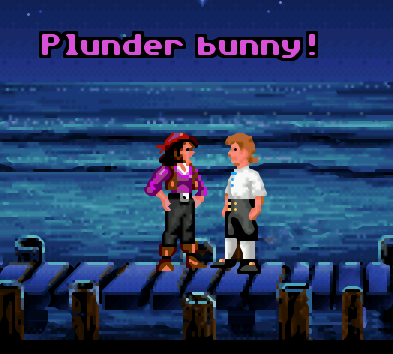
The Monkey Island Games
A series of video games, based on the same ride, based on pirates. Made by George Lucas’s videogame offshoot. Released way before Pirates of the Caribbean was a movie.

Now this is my favourite. Thoughout the series, which spans The Secret of Monkey Island, Monkey Island 2: LeChuck's Revenge, The Curse of Monkey Island and Escape from Monkey Island. We follow the story of young Guybrush Threepwood, a boy/man of humble origins and no real consequence who wants to be a pirate. There's Adventure, Romance, Insult Sword Fighting, and barely a drop of blood is spilt on-screen.

Whilst these games did not enjoy huge commercial success, they were successful by 90s standards, establishing and maintaining a cult following which has most recently manifested itself in the form of fansites (including The World of Monkey Island, The Scumm Bar, and Legend of Monkey Island). Through perusing these sites it is evident that the demographic attracted to hardcore Monkey Island fandom are not those who would be attracted to raping, pillaging, and perhaps not putting out the wheelie bins in a restrained attempt at rebellion.

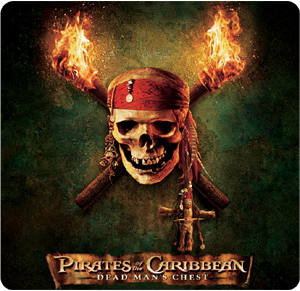
Pirates of the Caribbean 1, 2, and 3.
Three films based on a ride, based on pirates.

Yes, this next one is a bit obvious. But it had to happen. Keira Knightley, Johnny Depp, and Orlando Bloom. And yes, he is delicious. Action, Adventure, Rum-based humour, and jokes about whores here and there.

In terms of factual accuracy, apart from the mythical sea creatures and the somewhat relaxed relationship with the underworld, these films probably contain the greatest amount of historical information about pirate lifestyles. It's also the most widely known and successful. The first film, The Curse of the Black Pearl, grossed $654,264,015 worldwide on its own. Add to this the next two films, lunchboxes, DVD sales and Johnny Depp posters, and you're looking at a multi-billion dollar franchise.


Let's juxtapose all of this with the factual experience of pirating.

Rape, murder, lighting things on fire and terrible dental hygiene, not to mention premature death and countless other unpleasantries.

I guess the question I’m asking is this: Why is history such a useful framework for contemporary creative exploits? Because, let’s face it, we’re projecting contemporary morals, beliefs and narratives onto these men and women of lower moral (and probably also dietary) fibre. Is it the benefit of distance and hindsight which allows us to laugh in a twee fashion at people who lived more often than not in a state of abject poverty, and who frequently committed an number of acts which we ourselves would otherwise consider deplorable?

The floor is yours. Discuss.

Tuesday, April 22, 2008

Found Photographs

Visiting the Art Gallery of NSW on the weekend, I was intrigued to see (in the contemporary gallery downstairs) an exhibition of anonymous photographs, entitled Ghosts in the Machine. These mostly very small, black and white photographs were taken by unknown photographers and preserved by collectors. One the one hand, many of the photographs were poetic, absurd or surrealist images, often created by mistake. Yet they are also a precious record of everyday life, of ordinary people and the ways they sought to present themselves to the world -  we can gain access to a lost world through these private snapshots. These are the sorts of records Eurydice and Sharon might have yearned for when they were piecing together the life of Edna Lavilla, for example. They can also give us a sense of historical events from the point of view of the 'ordinary' person - one of the most striking (tiny) shots is of a group of WWII German soldiers running through the Hall of Mirrors in the Palace of Versailles. Who took the picture, and who was it for?

There are problems with this sort of work being exhibited, of course -  these were private photos that were never meant to become public, and I even found a website that offers 'vernacular photographs' for sale.  There is an intimacy to many of these images that made me feel slightly uncomfortable that they were on display in an art gallery, and not a history museum (or perhaps that they were on display at all). Are sites like flickr the contemporary equivalent of this phenomenon, where anyone can view anyone else's photographs, and where people who have posted their photos on these sites have found their images used in advertising campaigns? 


Tuesday, April 15, 2008

Forgotten History

It is interesting that Alec "Hunt Angels" Morgan should mention that large segments of history in Australia is forgotten information because it explains a lot of the reasons why Australians think and act as they do.

Then again, the same could be said of all countries and peoples which have been made subject to cultural imperialism from other more dominant nations. Be it Japan attempting to eradicate Korea's national heritage, Pol Pot attempting to re-write Cambodian mythology or Britain's Raj trying to keep India under its thumb, history has always been about power play and the repression of historical information.

In fact, my own heritage has been subject to just such a historical injustice.

In the early half of the twentieth century, the miners of Tonypandy (an industrial town in the Rhondda Valleys not far from where I grew up) led a peaceful protest against the coal board because they were not earning enough of a wage to feed their families. The MP assigned to deal with the strike was none other than that cruel drunk of a tyrant Winston Churchill, who rather than listening to the protestors ordered for mounted cavalry to ride in and trample them. Hundreds of men, women and children were killed in the ensuing chaos and Churchill became villified in the eyes of everyone in South Wales.

However, that incident was doctored and stricken from the record following the Second World War. As if helping Britain survive the onslaught of Nazi tyranny had stripped him of all wrong doing, Churchill was diefied as a national hero and historians were then coerced into altering the historical records as not to damage the romantic image which Churhill's legacy had created. Now children in South Wales are told that Churchill in fact REFUSED to use force and that the miners disbanded quietly after a few hours of negociation, but every one still knows the truth.

This acts as but another chapter in a long list of entries where State history and Folk history clash. Regardless of which side is correct, it must be noted that there is no real universal truth in this world and one's truth is another man's opinion. Hence it is just a matter of choice.

The Pointlessness of war

I've recently finished watching Park Chan-Wook's Joint Security Area - a film set around the supposedly infamous Bridge of No Return which seperates North and South Korea.

What I found particularly intriguing about this piece was the way in which it attempted to focalise the war from the perspectives of Soldiers from both sides who share the same view that the country should once more be unified and not from the typical nationalist binary of good/evil.

The interesting part comes when you consider that this perspective is also shared by many real people who live in other such conflicts and have appeared in non-fiction films. The best example I can think of off the top of my head comes from Oliver Stone's documentary Persona Non Grata when Stone's film crew was actually allowed to interview a Palestinian terrorist cell who claimed only to strive for a "unified, secular way of life".

The question I wish to pose is why in a partisan situation where both sides want the same thing does there still have to be so much pain and devastation. Why can't people just refuse to fight?

Of course, the problem with historical film comes from the opinion that it can also be used for reasons of propaganda to encourage hatred toward certain ethnic groups, with the best example being Leni Rifenstalh's Triumph of the Will. Even in today's supposedly liberally Democratic world, visual texts which work to provoke those sentiments of violence and hatred are still rampant.

Take, for instance, the upcoming Hugh Jackman film Australia, which attempts to document the Japanese air raid of Darwin's sea ports. Many people in the industry with whom I have discussed about this issue share my fears that this will become little more than a retelling of Pearl Harbor, hoping to promote Australian Nationalism and anti-Japanese feeling. The same can be said of all war films which promote partisan sentiments. War films or rather films about war often carry that emotional element which may lead to them becoming detrimental in a multicultural world and often have an adverse effect to what the film maker hopes to achieve.

Then again, these days it is not just films, books and newspapers which can promote war mongering attitudes. Television also palys a large part through the consistant coverage of veterans day, doctored news footage designed to only show the "good" segments of war and reality shows like Bad Lads Army which attempt to illogically 'reform' petty thugs by training them how to be killers.

The most partisan medium for attitudes to War is probably Videogames (yes, VGs are officially considered a legitimate form of media these days) which have since become the main forum of much debate on the ethics of war. On the one had, there are a swathe of RTS (Real Time Strategy) and FPS (First Person Shooter) games which appear to promote the concept of war and in the most extreme cases even glamorize it. On the other side of the spectrum are games like Metal Gear Solid and Assassin's Creed which attempt to contest these claims and prove that in war there can be no real good or bad side because the reasons people fight are always academic.

Perhaps what I am trying to get at with all this seemingly pointless philosophizing is, to quote Amnesty International's Howard Bell, humanity has not and can not advance as a species if we continue to consider war as a such an intrinsic part of our cultural heritage. Yes, greed and the desire for violence is part of human nature, but how long can people use those alibis to excuse the killing not just of soldiers but of innocent women and children. Not enough work has been done outside of niche market media to investigate the effects to which war has an effect on these people and it is a shame because that is exactly what wars are really about: people. Strip away all the layers of rhetoric and supposed meaning and one is left with the bare bones of what war is - human beings reverting back to their neolithic tendancies and killing other human beings.

More work should be done to promote truly egalitarian representations of how devastating war can be in order to finally ensure that the next generation can realise just how horrific wars really are and realise that we are all one species. One people...

Monday, April 14, 2008

Officialis

Trouble is brewing in the realm of Harry, Hermione and Ron, as questions of official-ness are brought into the light. JK Rowling is suing Steve Vander Ark, for his website/encyclopedia: HP Lexicon. Rowling alleges that the website, which is a very comprehensive collection of ideas arranged in an encyclopedic-hypertext format, has "simply taken it and copied it ... It is sloppy, lazy and it takes my work wholesale."

And in some regards Vander Ark has taken her words, at times quoting directly from Rowling in interviews she's given:

"I don't believe in witchcraft, though I've lost count of the number of times I've been told I'm a practicing witch. Ninety - let's say ninety five percent at least, of the magic in the books in entirely invented by me. And I've used things from folklore and I've used bits of what people used to believe worked magically just to add a certain flavor, but I've always twisted them to suit my own ends. I mean, I've taken liberties with folklore to suit my plot."
- J.K. Rowling on magic in the books (HPM)


But at the same time, he's also collated various essays from fans on topics dealing with the relevant issues:


What is interesting, even though this is is a fictitious story we're debating about, is the idea of officialness and its position as priviliged over 'unofficial' or 'rivalling' or 'fan' collections or archives. When we examine this in either media or history, we can see just how important this idea of officialness really is.

In media and history, the term official is a priviliged and ultimately highly sought after position, it brings about it an air of 'rightness' and infallibility. This idea can somewhat account for the formation of encyclopedia's as vestiges of the official literature/narrative and official accounts of certain events/objects/people.

But in the digital age, where the producer-consumer model is slowly being blurred, and the idea of sharing information, experiences, common knowledge and a swav of other things is fast becoming the norm, 'official' documents are now very wary of protecting their status. Things like creativecommons and Wikipedia represent the two biggest 'unofficial' collective works/archives on the Internet today and challenge this idea of the singular official entity or narrative as the predominant source or archive. This challenge has been one of the bigger issues of contention with the internet and the digital mediascape, particulary with the supposed advent (though, the Internet has always possessed such qualities from its very first inception) of Web 2.0.

So what does this mean for official archives in the future? Are they on their way out? What are the advantages of having these 'unofficial' sources, and how should we treat them as sources of information? Academia seems to be cautious to their uptake as 'acceptable' sources, but it seems like a matter of when rather than if these days.

What are your thoughts on the matter?

Friday, April 11, 2008

History "loved to death"

There has been a call to restrict the number of Australians who visit Gallipoli, according to an article in the Sydney Morning Herald (4.4.08) entitlted "Call for a Cap on Gallipoli Crowds". It basically states that as a result of an increase interest in history among Australians , the number of Australians who visit Gallipoli has increased and this has lead to a degredation of the environment . The upshot is that there is some discussion about limiting the number of tourists to Gallipoli , because according to historian Joan Beaumont the site is in danger of being "loved to death" and thus "further degredation of Gallipoli is inevitable."

Over the years attendance at Anzac Day services at Gallipoli has grown, so obviously there has been a renewed interest in public history by Australians, but perhaps the promotion of this site has come at a price. There seems to a fine line between promoting history and preserving it.
Furthermore the boundaries between history and tourism are nowdays blurred, creating a situation whereby shaping historical awareness through tourism is a common means for the public to connect with their history.

So can the public love their history too much?
Will public history do a full circle and only be accessible to historians, the public having to acquire their sense of history through other means?

Pip

Tuesday, April 1, 2008

mailto:aus08

The Powerhouse Museum has recently issued a 'call for emails' for its new project, which aims to 'preserve' a snapshot of ordinary life in Australia, 2008. The article identifies what I think has been the greatest advancement over previous histories, the ordinary person ability to contribute to the overall history, no matter how small, how insignificant they may seem, the blogs, photos, profiles, music tastes, email addresses, all intricately link us to forming our own little biography and history.

I think the project is trying to capture a greater sense of context for the people in the future, taking the guesswork out of history. But if this were the only thing to survive of our generation, and the emails the only reference point, I wonder how skewed the perception be of our society. This is as much as chance to try and secure a sense of immortality, who knows, maybe in 4000 years or so, we could have people reading these very blogs!

If we can't achieve physical immortality, is historical immortality the next best thing?!

Sunday, March 30, 2008

DJ Spooky

I first heard about DJ Spooky (aka Paul Miller) when he came to the Festival of Sydney a few years ago to perform his 'remix' of the infamous American film Birth of a Nation. Also known as The Clansmen (which might give you some clues about its politics), Birth of a Nation dramatised the history of the American Civil War. When it was released in 1915, US President Woodrow Wilson described the film as being 'like history written with lightning' - it is widely regarded as one of the first films to realise the potential of film as a medium for dramatising history. The film is notorious because it pretty much depicts the Ke Klux Klan as the saviours of American democracy, and the African American characters as either depicted as imbeciles or bestial, would-be rapists, played by white actors in blackface. DJ Spooky remixed the film (with a new score) to give the film's iconic images new meaning in a contemporary context - you can see an extract from the film here . Miller's remix uses the film against itself, repeating visual motifs and juxtaposing images in a new and (obviously) unintended ways. While the remix pulls the film apart and gives it new meaning, Miller commented that 'in a certain sense, what I'm doing is portraying the film as [Griffith] intended it', with its racism exposed through the re-presentation of the film its remixed form. 

On DJ Spooky's website, you can read his commentary on Rebirth of a Nation and also see his remix of the trailer of a fantastic seventies concert film, Wattstax. The trailer remix is a kind of history 'wink' from Miller to those who can read and understand the cues and signs (and especially sounds) he is offering to us. While his work is certainly not conventional documentary, it relies on the power of juxtaposition and a degree of audience familiarity with the material being presented - and isn't this a plausible description for a lot of 'media history'?

Wednesday, March 26, 2008

Who Do You Think You Are?

This parody of the television genealogy series Who Do You Think You Are? screened on the ABC last night on The Armstrong and Miller Show - I thought you might enjoy it!


Tuesday, March 25, 2008

History/Listening

Following this afternoon's discussion with Sharon Davis and Eurydice Aroney, I thought I might open up a space for us to discuss the possibilities and challenges that radio offers for making history. Radio tends to be overlooked when we think about history and media, but radio, as I think we all saw (heard?) opens up all sorts of new possibilities for communicating history to broad audiences. Radio's intimacy and scale are suited to different kinds of histories and Sharon and Eurydice's work shows how potent these can be when used well.

I'd be curious to hear what you think sorts of histories radio might suit, what works well on radio, and how you might come to terms with its limitations in making history-themed features, as well as your experiences with interviewing (which is common to most of the formats we're discussing and seems to spark intense discussion whenever we mention it).

Some links to explore that might be useful if you're suddenly contemplating reviewing a radio feature for your first assignment -
you can find BBC radio history programs, including a series on 1968, here, and Radio Eye, where 'The Search for Edna Lavilla' first aired, on ABC Radio National, here. There is already a link to Hindsight, the ABC's dedicated history program slot, on the right hand side of this page.

Tuesday, February 12, 2008

Film - Chicago 10

I've been excited by reports of a new documentary coming out of the United States about the Chicago 10. 1968 was arguably the highpoint of sixties radicalism, and the Democratic convention that year was the spark that lit a storm of protests. Antiwar protestors, from the student movement and SDS (students for a democratic society), to the Yippies and the Black Panthers, took to the streets in an infamous, violent clash with police. The subsequent media images of the clashes between protestors and police shocked the world (you can see some of this footage on You Tube). When you think of 'the sixties' of myth and legend, you probably have images from the 68 Democratic convention in mind. 10 organisers of the demonstrations, including Abbie Hoffman, Tom Hayden, and Bobby Seale, were put on trial on a (slightly dodgy) 'anti-riot ordinance', and the trial was frequently ridiculous, theatrical, and farcical.

So this new documentary, Chicago 10, directed by Brett Muller, mixes actual documentary footage of the protests (set against tracks by Eminem and the Beastie Boys) with motion-capture animation that recreates key moments of the trial (based on the transcripts). Using contemporary music would seem to give the footage new urgency by investing it with contemporary cultural meaning, and the animation allows the film to capture the unreal nature of the trial. Chicago '68 was a protest against American involvement in the Vietnam war: Muller claims that his film employs elements of the '60s but is actually set today, and the contemporary backdrop of America's involvement in Iraq seems like a parallel the director wants his audience to draw. One to watch out for.

Watch the trailer for Chicago 10 here: